As we move deeper into the current CAAPID cycle, the pressure is palpable. I know that for many of you, this is the most stressful time of the year. You are juggling document collection, bench test preparations, and the daunting task of summarizing your entire professional life into a single essay: the personal statement.
At International Dentist Central, my team and I review hundreds of personal statements every season. We have seen trends come and go, but this year, we are witnessing a phenomenon that is both fascinating and deeply concerning. It mirrors a trend sweeping across the entire media landscape, from social media content to journalism. We call it “AI Slop.”
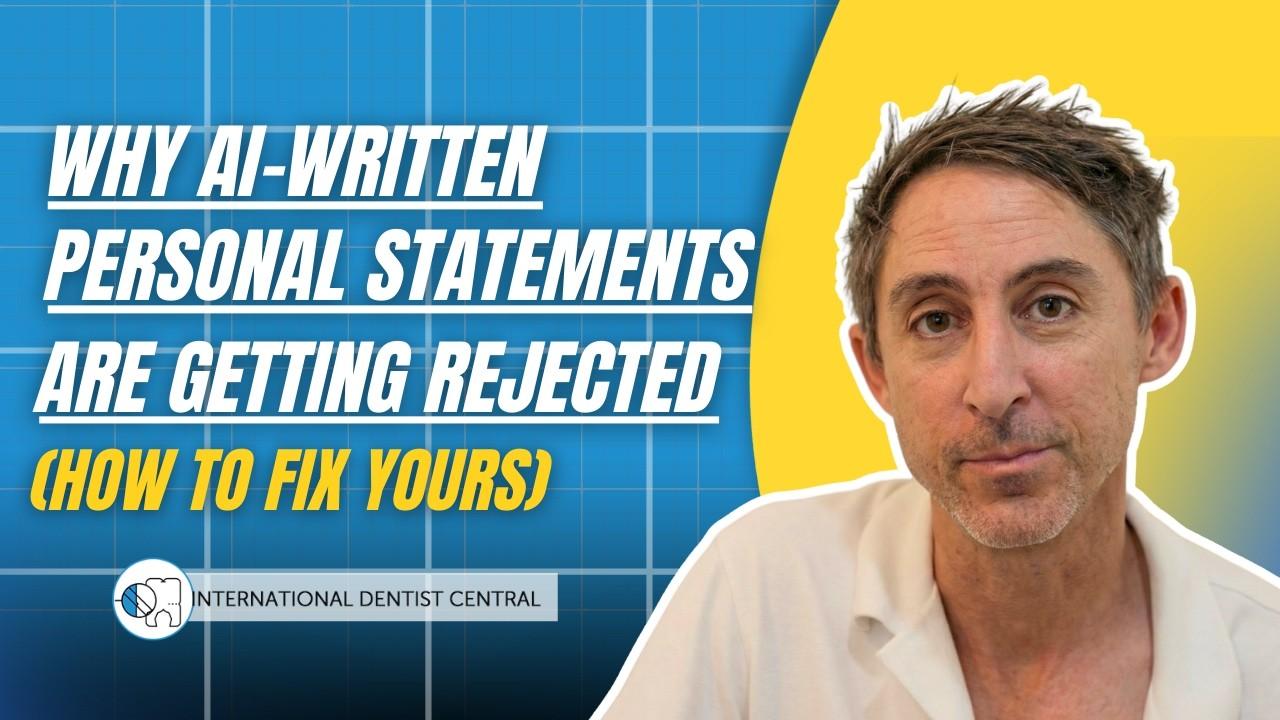
While artificial intelligence tools like ChatGPT and Claude are incredible technological feats, relying on them to write your dental school personal statement is becoming one of the most dangerous traps for international dentists. In this post, I want to break down exactly why AI-generated essays are backfiring, how admissions committees are spotting them, and what you actually need to do to stand out in a sea of algorithmic perfection.
The Rise of “Beautifully Boring” Essays
The allure of AI is understandable. English may not be your first language, or perhaps you feel insecure about your writing style. You input your CV into an AI tool, ask it to write a compelling personal statement, and within seconds, it spits out a grammatically flawless, sophisticated-sounding essay. It uses big words, complex sentence structures, and flows smoothly.
However, what we are seeing more and more frequently are essays that are “beautifully boring.” They are technically perfect but emotionally dead. They connect with no one. The primary job of a personal statement is not to prove you know how to use a thesaurus; its job is to connect with the reader—a human being—on an emotional and professional level.
If the reader (an admissions officer or faculty member) does not feel like they are getting to know the real you through those words, the essay has failed. It doesn’t matter if the grammar is Shakespearean; if the content is hollow, it falls flat.
Deconstructing the AI “Buzzword Salad”
Let’s look at a specific example. This is an excerpt based on a real draft we received recently (anonymized, of course) that was heavily influenced by AI. Read this carefully:
“My commitment to service is demonstrated through practical community engagement and underscores my dedication to fostering valuable skills like strategic thinking and my belief in contributing to community development.”
On the surface, this sounds professional. It sounds academic. But what does it actually mean? If you strip away the fancy phrasing, the candidate is essentially saying, “I like doing community service.”
The AI has taken a simple, human concept and inflated it with fluff. It uses words like “underscores,” “fostering,” and “strategic thinking” to mask a lack of specific detail. It is a lot of fancy words dancing around a very basic idea.
Here is another example from the same type of AI-generated content:
“My objective is to enroll in the international dentist program to align my extensive surgical expertise with the premier standards of US dental care. I am focused on mastering this profession’s ethical frameworks and evidence-based clinical methodology.”
This is what we call “speaking in vagaries.” phrases like “ethical frameworks” and “evidence-based clinical methodology” are buzzwords. They are the kinds of things you read in a textbook, not in a personal story. Of course you want to practice evidence-based dentistry—that is the bare minimum requirement for being a doctor. Stating it in this robotic way adds no value. It doesn’t tell the school how you practice, a specific time you faced an ethical dilemma, or a moment where evidence-based care saved a tooth.
The Connection Problem: Why “Perfect” is the Enemy of “Good”
When you use AI to write your statement, you are inadvertently removing the “personal” from the personal statement. The text becomes sanitized. It loses the grit, the struggle, and the unique voice that makes you, you.
AI tends to summarize attributes rather than demonstrating them. For example, an AI might write:
“I am confident that my core attributes, discipline, resilience, and a strong work ethic will enable me to meet the rigorous demands of the program.”
This is grammatically perfect. It is also completely unconvincing. Anyone can claim to be resilient. Anyone can claim to have a strong work ethic. In fact, “I am a hard worker” is the single most common cliché in personal statements.
When you let AI write this for you, it polishes the cliché until it shines, but it remains a cliché. A human writer—a successful applicant—wouldn’t just list “resilience” as an attribute. They would tell a story about a procedure that went wrong, how they panicked, how they calmed themselves down, fixed the issue, and what they learned from that failure. That is resilience. That creates a connection. AI struggles to do that effectively because it doesn’t know your life; it only knows predictive text patterns.
Raising the Bar, Lowering the Substance
There is a secondary consequence to this flood of AI content: it is artificially raising the bar for grammar while lowering the bar for substance.
Because so many applicants are using these tools, admissions committees are being inundated with essays that have perfect syntax. The baseline expectation for “good English” has skyrocketed. However, because these essays are all pulling from the same data sets and language models, they all start to sound the same.
It creates a sea of homogeneity. When a faculty member reads 50 essays in a day, and 25 of them use the exact same sentence structure to describe “bridging the gap between cultures” or “integrating into the US healthcare system,” they all blur together. You stop being a unique individual and start becoming just another output of the algorithm.
The irony is that by trying to sound “better” using AI, candidates are actually blending in more. To stand out in an environment where everyone sounds perfect, you need to be willing to sound human—which sometimes means being simpler, more direct, and less “fancy.”
The Detection Risk: Yes, They Know
Beyond the stylistic issues, there is a very practical risk: detection.
I have seen candidates who believe that their AI-written essays are undetectable. That is simply not true. When we run some of these “beautiful” essays through AI detectors, they often hit anywhere from 95% to 100% probability of being AI-generated.
Dental schools are academic institutions. They have access to sophisticated plagiarism and AI detection software (like Turnitin and others). It costs them next to nothing to scan your application. If your personal statement comes back flagged as 100% AI, what does that say about you to the admissions committee?
- It suggests laziness. It implies you weren’t willing to put in the effort to write your own story.
- It questions your integrity. Are you presenting yourself authentically?
- It implies a lack of communication skills. Can you communicate with patients, or do you need a script?
I have spoken to candidates who admitted to generating their statement and pasting it into CAAPID without even fully reading it. If you aren’t willing to read your own personal statement, why should a professor be excited to read it? If the detector flags you before a human even lays eyes on your paper, you may have disqualified yourself before the race even started.
How to authentically Use Technology
Am I saying you should never use a computer to help you? Of course not. But there is a massive difference between using tools for assistance and using them for creation.
Do Not:
- Ask ChatGPT to “Write a personal statement for a foreign-trained dentist.”
- Copy and paste large blocks of text from an AI directly into your application.
- Ask AI to “rewrite this to sound more professional” (this usually just adds the “AI slop” buzzwords).
Do:
- Write your first draft entirely by yourself. It doesn’t have to be perfect; it just has to be yours.
- Use tools to check for basic grammar errors after you have written your thoughts.
- Focus on “Show, Don’t Tell.” Instead of saying you are compassionate, describe a specific interaction with a patient.
- Read your essay out loud. If you stumble over a word like “multifaceted” or “underscores,” or if it sounds like something a robot would say, cut it. Use language you would actually use in a conversation.
The Verdict
Your personal statement is your one chance to speak directly to the committee before an interview. It is your proxy. It needs to carry your voice, your passion, and your specific experiences.
Don’t let the temptation of a “perfect” AI essay trick you into submitting something hollow. An essay that is 90% perfect grammatically but 100% authentic and moving will always beat an essay that is 100% grammatically perfect but reads like a technical manual.
The schools are looking for future colleagues, not chatbots. Be brave enough to be yourself on the page. If you are struggling to find your voice or want a human set of eyes on your statement to ensure it sounds like you and not a machine, my team at International Dentist Central is here to help you refine your story authentically.

Leave A Comment