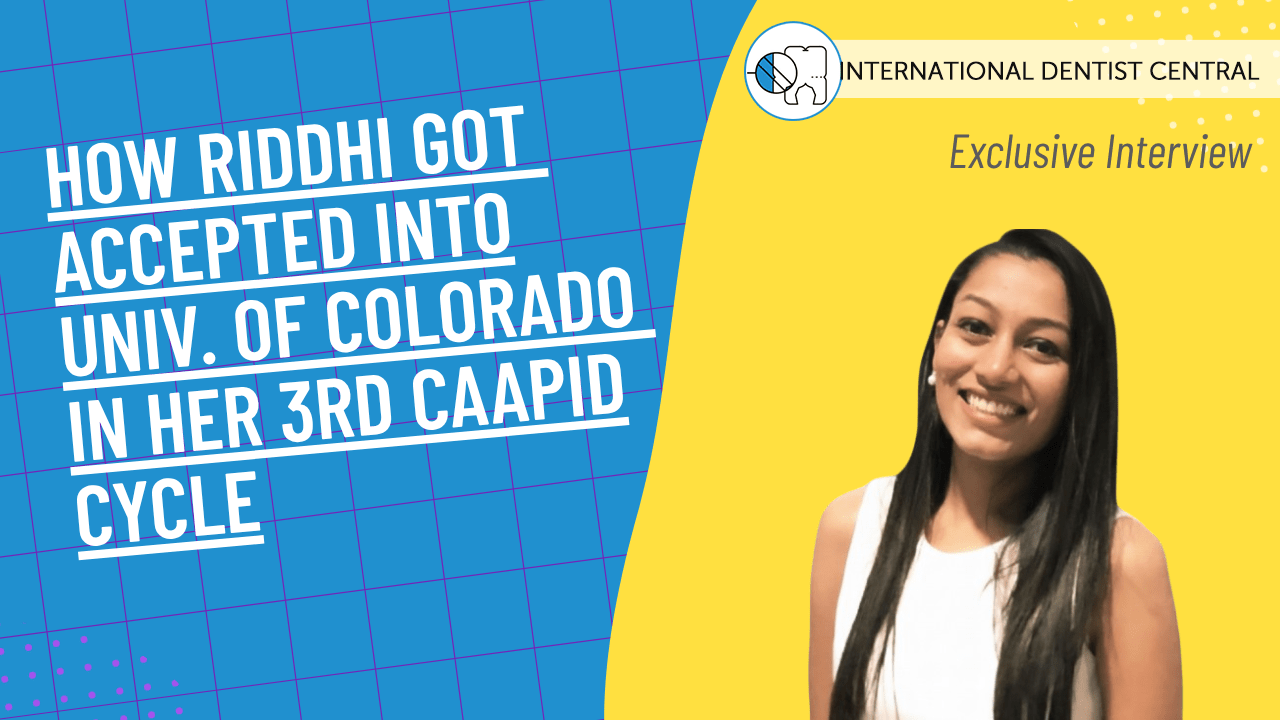
The journey of an international dentist in the United States is rarely a straight line. It is a path paved with rigorous exams, complex applications, and, quite often, the emotional toll of multiple application cycles. However, as a Dental School Application Expert and Interview Coach, I have seen that success in the CAAPID process is not merely a matter of luck; it is a result of meticulous strategy, the willingness to evolve, and a “stubborn hope” that carries an applicant through the dark days. Recently, I had the pleasure of witnessing one of my clients, Riddhi, achieve her dream of acceptance at the University of Minnesota. Her story is a masterclass in how to turn a non-traditional background into a winning profile.
The Long Road to “Yes”: Understanding the CAAPID Cycle
For many international dentists, the first cycle is an introduction to the sheer scale of the competition. Riddhi’s journey spanned three cycles, a timeline that is becoming increasingly common in today’s competitive landscape. In her first and second cycles, she received interviews but no final acceptance. It was only in her third cycle—her first time applying to the University of Minnesota—that everything aligned. What changed? It wasn’t just her CV; it was her approach to her entire application.
Many applicants believe that if they have a BDS and have passed their boards, they are ready. But the CAAPID process requires a deeper level of self-reflection. You must be willing to break down your personality and your history to see what is working and what is not. Riddhi’s success underscores the importance of not just “applying again,” but applying differently.
Strategic Timing: The “March Advantage” in Rolling Admissions
One of the most common errors applicants make is underestimating the power of the timing when it comes to submitting applications. In her first cycle, Riddhi applied in July. In her second, she applied in May/June. In both instances, despite having a strong profile, she was fighting an uphill battle against time. By her third cycle, she ensured every document was submitted by the end of March.
The University of Minnesota is a prime example of a school that where timing is important. They move quickly, sending out Kira interviews as early as April and concluding their bench tests by June. If you wait until June to submit, you are effectively applying for the few remaining spots, if any are left at all. Being “early” isn’t just a suggestion; it is a tactical necessity. Applying in March allows the admissions committee to view your profile when their “mental fatigue” is low and their “acceptance capacity” is high.
Leveraging Non-Traditional Experiences: The MHA Advantage
A common concern among international dentists is how to explain gaps in clinical practice. Riddhi spent over five years working in healthcare administration in the U.S. after completing her Masters in Healthcare Administration (MHA). On the surface, some might see this as a “weakness” because it took her away from the dental chair. However, her and I worked hard together to flip this narrative in her personal statement.
Dentistry is not just a clinical pursuit; it is an entrepreneurial one. By framing her MHA and her administrative experience as a foundational step toward becoming a “dental entrepreneur,” her profile became unique. She wasn’t just another dentist; she was a clinician who understood the financial, insurance, and operational side of running a multi-specialty practice. This is a vital lesson for all applicants: any experience—whether in public health, administration, or even research—can be a strength if you can connect the dots for the admissions committee.
The Statement of Purpose: Your Personal Index of Success
The Statement of Purpose (SOP) is arguably the most precious document in your application. Riddhi noted that in her first two cycles, she changed her SOP, but she didn’t change it *enough*. The themes remained stagnant. In her third cycle, we worked through an organic process of bringing her genuine personality to the surface.
Your personal statement should serve as a short summary to the “book” of your life. If the summary is boring, no one will want to read the book. We focused on making sure her SOP was more than just a regurgitation of her CV. We ensured her SOP clearly defined not only what she accomplished, what who she is, and what drives her. Boldly stating what you’re about removes uncertainty for the admissions committee and makes it easier for them to say “yes.”
Profile Deep Dive: From GPA Concerns to Research Excellence
Many applicants lose sleep over a GPA that they feel is “average.” Riddhi’s BDS GPA was 3.25—respectable, but not at the top of the pool. To counter this, she leveraged her MHA GPA of 3.6 to show academic effectiveness. This demonstrated to the committee that she could handle the rigors of a U.S. academic environment.
Furthermore, Riddhi built a robust research profile with the University of Michigan. By volunteering as a researcher and eventually becoming a journal reviewer, she showed a commitment to the advancement of dental science. This level of engagement goes beyond the “box-ticking” that many applicants do. It shows that she is a leader in the field, not just a student.
Standardized Testing Mastery: Her 116 TOEFL Achievement
While schools understand you’re not applying to an English Literature PhD, they still need to ensure you can understand their program’s academic material and communicate well. Many schools set a “minimum” TOEFL score of 100, so a score of 116 (which Riddhi achieved) communicates something in itself. Strong TOEFL scores tell the schools that they will never have to worry about your ability to interact with patients, faculty, or peers. In Riddhi’s case, it showed her willingness to go the extra mile to conquor a difficult exam. If your TOEFL score has expired or is hovering near the minimum, retaking it to show an upward trend is a powerful way to signal your dedication to improvement.
The Technical Edge: Mastering the Bench Test and Interview
Getting the invite is only half the battle. You must be prepared to perform. Riddhi recognized that because she had been away from clinical practice, her bench test skills needed a professional “refresh.” She invested in a hands-on bench test program, treating it like a crash course to bridge the gap between her administrative work and the clinical requirements of U.S. schools.
For the interview, Riddhi used her own professional background in healthcare administration—where she had been the one conducting interviews—to understand the “other side” of the table. She practiced with non-clinicians to ensure her message was clear and structured. This “vigilance” in preparation meant that when the invite arrived, she wasn’t starting from scratch; she was already “bang on” and ready to execute.
Navigating the Dark Days: The Psychology of a Third-Cycle Applicant
We cannot discuss Riddhi’s success without acknowledging the emotional resilience required. There were days of demoralization and days of questioning whether her past “failures” (such as a previous attempt at Part 1) would define her forever. The key was acceptance. Once she accepted that her past attempts were a permanent part of her profile, she stopped worrying about them and started focusing on what she *could* control: her research, her volunteering, and her current clinical knowledge.
Having supportive family members in her life was instrumental for Riddhi. They kept her disciplined and helped with the non-dental research that the CAAPID process requires. For those applying without a local support system, it is vital to find mentors and peers who can offer that “right push” when you feel like giving up. This is one of the reasons we offer All-In with IDC; a program desiged to keep you motivated and on informed throughout the entire process.
Final Takeaways for the International Dentist
Riddhi’s acceptance to the University of Minnesota is a testament to the fact that “the day will come” if you stay the course. If you are currently in the middle of a difficult cycle, remember these key points:
- Time is your greatest asset: Submit in March. Don’t wait.
- Connect the dots: Every piece of your history has value if framed correctly.
- Professionalism in the details: Even the way you label your uploaded documents (e.g., Firstname_Degree_Format) speaks to your organizational skills.
- Stay vigilant: Don’t just watch webinars—take one tip from each and implement it.
The CAAPID process is getting tougher every year, but that only makes the eventual victory more meaningful. When you finally cross that bridge, you aren’t just becoming a US dentist; you are becoming a survivor of one of the most grueling academic processes in the world. Your bright future is just around the corner.

Leave A Comment