


For internationally trained dentists trying secure a seat in a US Advanced Standing program, the bench test is the ultimate hurdle. (It certainly was for me, more than a decade years ago). Among the various procedures you’ll be asked to perform, the Class II cavity preparation stands as the quintessential test of skill, precision, and theoretical understanding. It is often the “make or break” component of the examination.
In this comprehensive guide, I’ll dive into some of the nuances of the ideal Class II cavity preparation. Whether you are practicing for your first bench test or refining your technique for this cycle, this post will provide the clinical measurements, step-by-step instructions, and expert tips you need to excel. That said, there’s so much to say about this topic, that this post can only really scratch the surface. For those who want to go deeper, I’d recommend checking out my online Bench Test Mastery, where I not only go much further detail on Class II cavity preps, but where I also provide personalized feedback.
Principles of Class II Preparation
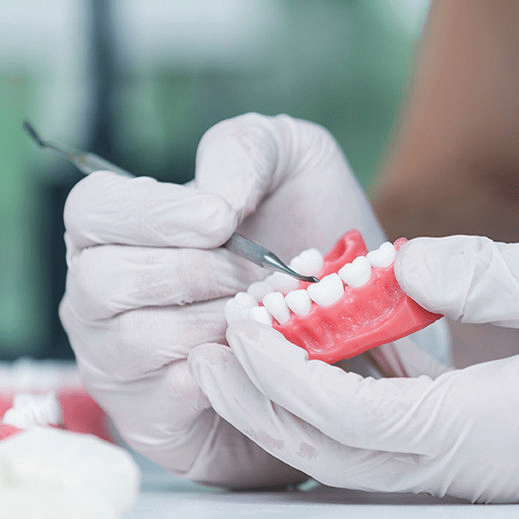
The Class II amalgam preparation is based on G.V. Black’s classic principles of cavity preparation. Even in the age of composites, Black’s principles remain the gold standard for bench tests grading.
1. Outline Form
The outline form must include all carious areas. For an ideal Class II cavity preparation on a typodont with no simulated caries, the outline should follow the pits and fissures of the occlusal surface and extend through the marginal ridge to create the proximal box. The transitions should be smooth, with no sharp corners.
2. Resistance Form
Resistance form prevents both the restoration and the tooth from fracturing under occlusal forces. Key features include:
- Pulpal Depth: A minimum of 1.5mm to 2.0mm to ensure sufficient bulk of amalgam.
- Flat Pulpal Floor: Perpendicular to the long axis of the tooth to distribute forces evenly.
- Rounded Internal Line Angles: To reduce stress concentration (the axiopulpal line angle is the most critical to bevel/round).
- Box Design: 90-degree cavosurface margins.
3. Retention Form
Since amalgam does not bond to the tooth, mechanical retention is vital. This is achieved by:
- Occlusal Convergence: The buccal and lingual walls of the occlusal step and the proximal box should converge slightly toward the occlusal (approx. 6 degrees).
- The “Dovetail”: Prevents proximal displacement of the restoration. Composite preparations do not require a dovetail.
- Retention Grooves: Placed in the axiobuccal and axiolingual line angles of the proximal box. This feature is rarely requested, as occlusal convergence provides ample retention, but certain programs do ask for the grooves. Composite preparations do not require them.
Step-by-Step Guide to the Ideal Class II Prep
Success in a bench test comes from a systematic approach. Breaking the Class II cavity prep into two distinct phases—occlusal and proximal—will help you maintain control and precision.
Phase 1: The Occlusal Step
Start by entering the tooth through the most carious pit (usually the central pit) using a #330 bur.
- Initial Entry: Orient your bur parallel to the long axis of the tooth. Enter to a depth of 1.5mm. Use the length of the bur head as a guide (a #330 bur is approximately 1.6mm long; use it as your mark).
- Extension: Extend along the central groove. Maintain a uniform depth and width. The isthmus width should ideally be 1.0mm or 1/4th the intercuspal distance. After the initial pass, the isthmus should be narrower than 1mm.
- Convergence: Ensure the buccal and lingual walls converge. This is naturally achieved if you hold the bur parallel to the long axis, as the #330 bur has a slight taper.
- The Dovetail: Extend into the opposite pit (e.g., the distal pit if you are prepping an MO) to create a dovetail. This provides resistance against displacement.
Phase 2: Dropping the Proximal Box
This is where many candidates struggle. The goal is to “drop the box” while preserving the “eggshell” of enamel that protects the adjacent tooth.
- The Trenching Technique: Move toward the marginal ridge. Thin the ridge until there’s about 0.5mm left. Begin moving the bur gingivally in a “pendulum” motion (bucco-lingually) or drop down to the gingival floor depth at once with another ‘punch cut’, then extend bucco-lingually, while maintaining the convex contour of the axial wall.
- Gingival Seat: Drop the seat until you have 0.5mm clearance from the adjacent tooth. The gingival seat width should be approximately 1.2mm mesiodistally .
- Breaking Contact: Once the box is dropped and extended bucco-lingually, thin out the shell until it’s translucent with a bur. Then use a hand instrument (like a hatchet or a thin explorer) to break the final “eggshell” of enamel. This prevents nicks on the adjacent tooth.
- Refining the Box: Use an enamel hatchet to smooth the buccal and lingual walls of the box. Ensure they are 90 degrees to the external surface to satisfy the 90-degree exit angle criteria.
Ideal Measurements: Clinical Standards for Bench Tests
To score high, you must memorize these measurements. During practice, use a periodontal probe or a (non-rotating #330 bur) to verify every dimension of your Class II cavity preparation.
| Feature | Measurement (Ideal) | Reasoning |
|---|---|---|
| Pulpal Depth | 1.5 mm – 2.0 mm | Ensures material strength and prevents fracture. Extending into the DEJ ensures caries are removed. |
| Isthmus Width | 1.0 mm (or 1/4 intercuspal) | Preserves tooth structure while providing access. |
| Gingival Seat Width | 1.2 mm | Provides a stable base for the restoration. |
| Proximal Clearance | 0.5 mm (B, L, and G) | Allows for proper finishing and hygiene. |
| Axial Wall Height | 0.6-1.4mm | Depends on the tooth’s anatomy and box depth. |
| Cavosurface Angle | 90 Degrees | Prevents marginal chipping of the restorative material. |
Common Mistakes and How to Avoid Them
Even seasoned clinicians struggle with the Class II cavity prep under the pressure of a bench test. Here are the most common pitfalls and how to navigate them.
1. Over-Extension
Over-extending the buccal or lingual walls of the box is a frequent error. This happens when you try to break contact using the bur alone. The fix: Leave the thin shell of enamel and use your hatchet. It gives you 100% control over the margin.
2. Nicking the Adjacent Tooth
Use a matrix band (fender wedge or a simple Tofflemire band) around the adjacent tooth during the trenching phase if you must. However, the best protection is a steady hand and leaving that “eggshell” of enamel.
3. Hand Instability
Unstable hands lead to wobbly preps. The fix: Always establish a solid finger rest (fulcrum). Do not hover your hand. Rest your ring finger on a stable tooth in the same arch. Establish good prep technique; it’s worth the time and effort it takes many times over.
4. Inconsistent Floors
A “stepped” pulpal or gingival floor indicates poor handpiece control. The fix: Use a #330 bur with light, sweeping motions (think of feather-light touches). This is another aspect of the prep that will mostly fix itself once you have good technique.
Tools Needed for the Perfect Prep
Your “armamentarium” is your best friend. For an ideal Class II cavity preparation, you should have the following ready:
- High-Speed Handpiece: For bulk reduction and initial outline.
- Burs: #330 and #245.
- Enamel Hatchet (10-7-14 or 15-8-14): Essential for smoothing proximal walls and squaring the gingival seat.
- Gingival Margin Trimmer: To place the final bevel/curve on the gingival margin (if required) and round the axiopulpal line angle.
- Explorer and Periodontal Probe: Your most important measuring tool.
Conclusion
The Class II cavity preparation is more than just a dental procedure; it is a demonstration of your discipline and attention to detail. By mastering the ideal measurements, refining your step-by-step guide, and avoiding common mistakes like over-extension or adjacent tooth damage, you will place yourself ahead of the competition.
As you prepare for a bench test, remember that practice quality trumps quantity. Perform one “perfect” prep every day rather than ten mediocre ones.
Have you been practicing and would like some professional input? I’ve been helping internationally-trained dentists like yourself improve their bench test readiness for over a decade. Click here to get a complimentary prep evaluation with me.
Are you struggling with a specific aspect of the Class II prep? Leave a comment below, sign up for our newsletter, or join our community of international dentists for more bench test tips!

Leave A Comment