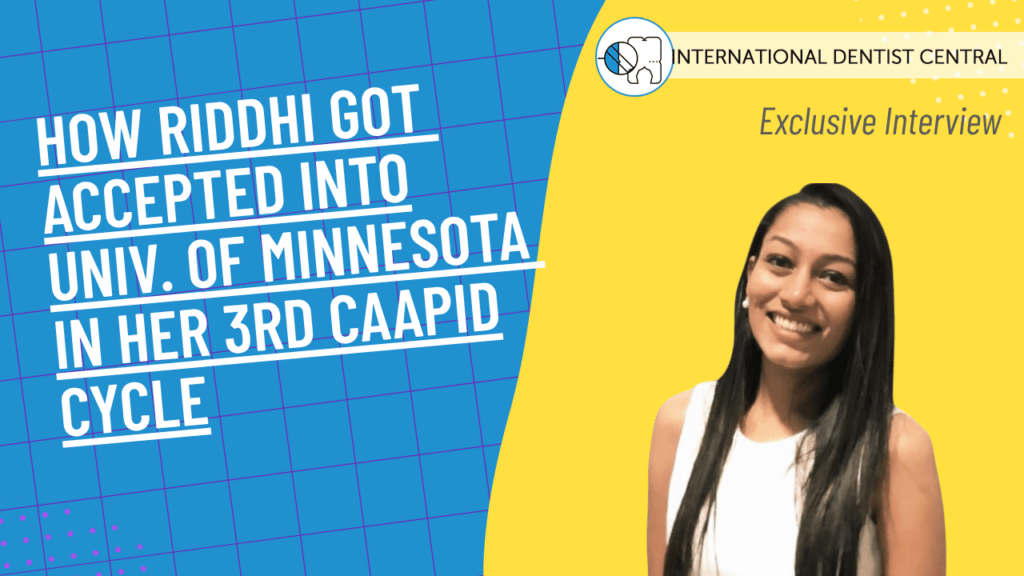
The journey of an international dentist in the United States is rarely a straight line. It is paved with rigorous exams, complex applications and, quite often, the emotional toll of multiple application cycles. Riddhi’s story shows what can change in a third CAAPID cycle when you stop just applying again and start applying differently.
As a dental school application expert and interview coach, I have seen that success in the CAAPID process is not a matter of luck. It comes from meticulous strategy, a willingness to evolve and a “stubborn hope” that carries you through the dark days. I recently watched my client Riddhi earn her acceptance at the University of Minnesota, and her story is a masterclass in turning a non-traditional background into a winning profile.
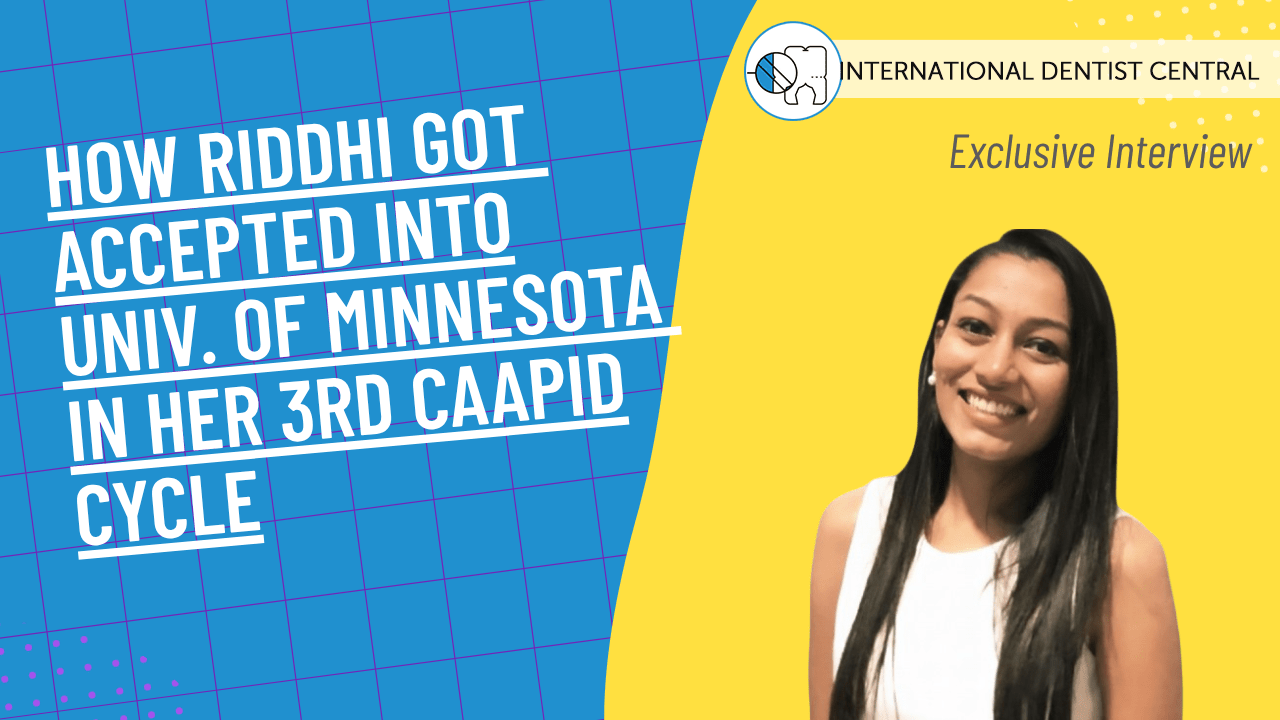
The Long Road to “Yes”: Riddhi’s Third CAAPID Cycle
For many international dentists, the first cycle is an introduction to the sheer scale of the competition. Riddhi’s journey spanned three cycles. In her first and second cycles, she received interviews but no acceptance.
It was only in her third CAAPID cycle, and her first time applying to the University of Minnesota, that everything aligned. What changed? It wasn’t just her CV. It was her approach to her entire application.
Many applicants believe that once they have a BDS and have passed their boards, they are ready. But the CAAPID process requires deeper self-reflection. You must be willing to look honestly at your profile and history to see what is working and what is not.
Strategic Timing: The “March Advantage”
One of the most common mistakes applicants make is underestimating the importance of timing. In her first cycle, Riddhi applied in July. In her second, she applied in May and June. Both times, despite a strong profile, she was fighting an uphill battle against the clock. In her third CAAPID cycle, she made sure every document was submitted by the end of March.
The University of Minnesota is a good example of a school where timing matters. In Riddhi’s cycle, the school moved quickly, sending Kira interview invitations as early as April and finishing bench tests by June. If you wait until June to submit, you may be competing for the few spots that remain.
Being early isn’t just a suggestion; it is a tactical advantage. Applying early lets the admissions committee review your profile while they still have plenty of seats to fill. Always check each program’s current timeline on the ADEA CAAPID program finder.
Leveraging Non-Traditional Experience: The MHA Advantage
A common concern among international dentists is how to explain gaps in clinical practice. Riddhi spent over five years working in healthcare administration in the U.S. after completing her Master’s in Healthcare Administration (MHA). On the surface, some might see this as a weakness because it took her away from the dental chair.
However, she and I worked hard in the CAAPID Application Solution to flip this narrative in her personal statement.
Dentistry is not only a clinical pursuit; it is also an entrepreneurial one. By framing her MHA and administrative experience as a foundation for becoming a dental entrepreneur, her profile became unique. She was a clinician who understood the financial, insurance and operational side of running a multi-specialty practice.
This is a vital lesson for every applicant: any experience, whether in public health, administration or research, can be a strength if you connect the dots for the admissions committee. If you are considering a public health degree, see our list of MPH programs for international dentists.
The Statement of Purpose: Your Personal Index of Success
The statement of purpose (SOP) is arguably the most precious document in your application. Riddhi noted that in her first two cycles, she changed her SOP, but not enough. The themes stayed the same. In her third CAAPID cycle, we worked through an organic process of bringing her genuine personality to the surface.
Your personal statement should be a short summary of the “book” of your life. If the summary is boring, no one will want to read the book. We made sure her SOP was more than a repeat of her CV. It clearly showed not only what she had accomplished, but who she is and what drives her. Clearly stating what you are about removes uncertainty for the committee and makes it easier for them to say yes.
Profile Deep Dive: From GPA Concerns to Research Excellence
Many applicants lose sleep over a GPA they feel is average. Riddhi’s BDS GPA was 3.25, respectable but not at the top of the pool. To balance this, she highlighted her MHA GPA of 3.6, which showed the committee that she could handle the rigor of a U.S. academic environment.
Riddhi also built a strong research profile with the University of Michigan. By volunteering as a researcher and eventually becoming a journal reviewer, she showed a real commitment to advancing dental science. This level of engagement goes beyond box-ticking. For another example of persistence paying off, read this seven-year journey to acceptance.
Standardized Testing: Her 116 TOEFL Score
Schools know you are not applying to an English literature PhD, but they still need to know you can understand their academic material and communicate well with patients, faculty and peers.
Many programs publish a minimum TOEFL score, and a score well above that minimum, like Riddhi’s 116, sends a clear message. It also showed her willingness to go the extra mile on a difficult exam. If your TOEFL score has expired or sits near a program’s minimum, retaking it to show improvement can signal your dedication.
The Technical Edge: Mastering the Bench Test and Interview
Getting the invitation is only half the battle. You must be prepared to perform. Because she had been away from clinical practice, Riddhi knew her bench test skills needed a professional refresh. She invested in a hands-on bench test program, treating it as a crash course to bridge the gap between her administrative work and the clinical expectations of U.S. schools.
For the interview, Riddhi drew on her healthcare administration background, where she had conducted interviews herself, to understand the other side of the table. She practiced with non-clinicians to make sure her message was clear and structured. When the invitation arrived, she wasn’t starting from scratch. She was ready.
Navigating the Dark Days of a Third-Cycle Applicant
We cannot discuss Riddhi’s success without acknowledging the emotional resilience it required. There were days of discouragement and days of wondering whether past setbacks, such as a previous attempt at NBDE Part 1, would define her forever.
The key was acceptance. Once she accepted that her past attempts were a permanent part of her profile, she stopped worrying about them and focused on what she could control: her research, her volunteering and her current clinical knowledge.
Supportive family members were instrumental for Riddhi. They kept her disciplined and helped with the non-dental research the CAAPID process requires. If you are applying without a local support system, find mentors and peers who can give you the right push when you feel like giving up. That is one reason we offer All-In with IDC, a program designed to keep you motivated and informed throughout the entire process.
Final Takeaways for Your Third CAAPID Cycle (or Any Cycle)
Riddhi’s acceptance to the University of Minnesota shows that the day will come if you stay the course. If you are in the middle of a difficult cycle, remember these key points:
- Time is your greatest asset: submit early, ideally in March. Don’t wait.
- Connect the dots: every part of your history has value if you frame it well.
- Professionalism in the details: even how you name your uploaded documents (for example, Firstname_Degree_Format) shows your organizational skills.
- Stay vigilant: don’t just watch webinars. Take one tip from each and put it into practice.
The CAAPID process is demanding, but that makes the eventual victory even more meaningful. Whether this is your first or your third CAAPID cycle, the right strategy can change the outcome. When you finally cross that bridge, you won’t just be becoming a U.S. dentist; you will have come through one of the most grueling application processes there is. Your bright future is just around the corner.