Dental burs, especially diamond burs, can be confusing. There are many types, grits and even different numbering systems. The good news is that you do not need to memorize every number to do a great crown preparation for your bench test.
In this guide, we cover the dental burs that are commonly used and reliable for crown preparations, how to read their color codes and which burs to use for each step of the prep.
Table of Contents
How to Read Dental Burs Numbers
Here is a quick tip: in a diamond bur number such as 856-016, the first three digits indicate the shape of the bur, and the last three digits indicate its size. The larger the size number, the larger the diameter.
Still, do not get too tied up in numbers. Burs are simply the tools we use to reduce tooth structure. In the end, what matters is how the final preparation looks, not which burs you used.
Keep in mind that the tip of the bur determines the final shape of your margins. Whatever bur you use, your angulation must be right for your prep to look good.
Check Your Burs Before You Use Them
If you bought different burs from the ones listed here, or you are given different burs on test day, check the shape of the tips first. You can use a perio probe or a #330 bur to measure them.
Always confirm that a bur suits the margin you want before using it on the tooth. No two dentists recommend exactly the same set of burs, so feel free to experiment until you find what works best for you.
Tapered Burs for Axial Walls
Some textbooks still show parallel burs for preparing the axial walls of a crown. Today, however, a slight taper of about 3 to 4 degrees per wall (6 to 8 degrees in total) is advocated. This taper allows proper draw and seating of the crown and makes it easier to take impressions without distorting the material.
You can create this taper with a parallel bur, but it depends heavily on your angulation skills and often leads to undercuts or a prep with no draw. That is why most crown prep burs are now tapered. As long as you hold the bur along the long axis of the tooth, or the path of draw, the taper takes care of itself.
Color-Coded Diamond Burs
Diamond burs have a colored stripe on the shank that indicates their grit:
- Black: super coarse
- Green: coarse
- Blue: medium
- Red: fine
- Yellow: super fine
- White: ultra fine
The coarser the grit, the faster the bur cuts tooth structure. On a bench test, you will most likely be given a green or a red bur.
Diamond Burs vs. Carbide Burs
Carbide burs leave a smooth surface, while diamond burs leave a rough surface. For crown preparations, we want that rough surface.
The roughness gives the cement something to hold on to and creates friction that helps prevent the crown from coming off. In this way, it enhances retention, which is why we do not polish a crown prep afterward.
Best Dental Burs for Occlusal Reduction
You can use any cylindrical bur, but we recommend a #556 bur. It has more serrations, so it cuts tooth structure better and faster. Many people use the #56 bur they used for cavity preps. It has the same dimensions but cuts less efficiently and can leave burn marks on the tooth. If you are buying burs, get a #556 for crown preps.
A tapered bur is not recommended for occlusal reduction, because the reduction must be uniform over the cusp tips and grooves. With a tapered bur, the tip removes less than the part near the shank, and you must be even more careful with angulation.
Some programs may give you only diamond burs, such as a chamfer or shoulder bur. You can still do the reduction, but pay close attention to angulation and make your depth cuts as accurate as possible before reducing the occlusal table. Learn more in our introduction to occlusal reduction.
Dental Burs for Finish Lines
Chamfer Margins
Chamfer margins are used for full metal or gold crowns and for the lingual margins of metal-ceramic crowns.
Use an 856-014 bur (tip diameter 0.9 mm) or an 856-016 bur (tip diameter 1.1 mm). The only difference between them is the diameter of the tip. Some people avoid the larger one because it feels intimidating, but try both and see which suits you.
Whichever bur you use, technique matters most. To create a clean chamfer, do not fully engage the whole tip. Keep about half of the bur’s diameter outside the margin.
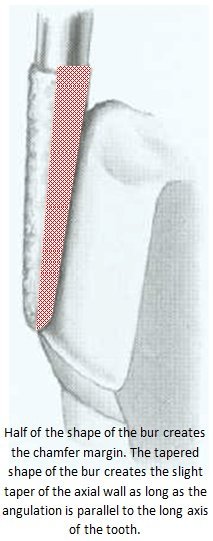
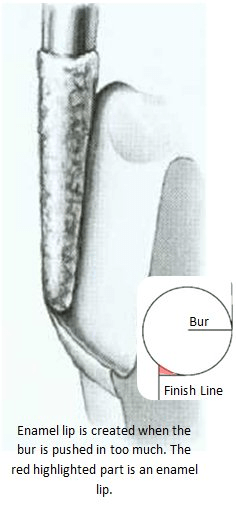
A chamfer is only about 0.5 mm wide, so half the tip diameter is enough to create it. If you engage the whole tip, you are likely to create a deep chamfer and leave enamel lips. Unsupported enamel is a serious mistake on the bench test. See our guide to full gold crowns with chamfer margins.
Some clinicians suggest an 878K-016, also called a gingival curettage or torpedo bur. It has a pointed tip, which can scrape the gingiva, gouge the margins and increase the risk of enamel lips.
Shoulder Margins
Shoulder margins are used for all-ceramic crowns and the buccal margins of metal-ceramic crowns.
Use a flat-tipped bur with well-defined corners, such as an 847KR-016 (flat-end tapered, modified). Its 1.1 mm diameter works well for a shoulder width of about 1.2 mm. When using this bur, fully engage the whole tip within the margin.
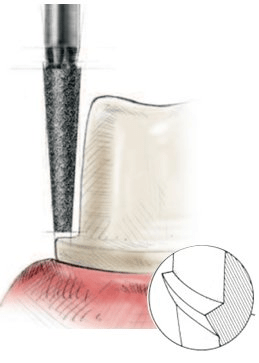
Some programs give you chamfer burs to make the margin for a ceramic or metal-ceramic crown. Classically, this should be a shoulder, but there is nothing wrong with this approach. In a clinical setting, a clinician often produces a clinically acceptable shoulder or a deep chamfer, and modern materials can accommodate these margins as long as the reduction leaves enough bulk for the material.
So if you are given a chamfer bur, use it as you would a shoulder bur, provide the same reduction and always remove any unsupported enamel afterward. Hand instruments work well for this.
Finishing the Margins
An end-cutting bur lets you finish a shoulder margin without touching the axial wall. A less aggressive option is to use the hand instruments you already use for cavity preparations.
Proximal Reduction
A needle-shaped bur is effective for breaking the proximal contact because it helps you avoid nicking the adjacent tooth. A 859L, 820-012 or 169L bur will do the job.
Anterior Lingual Reduction
The lingual surface of anterior teeth is concave, or spoon-shaped. An egg-shaped bur is the better choice for reducing it. A football-shaped bur has a pointed tip that may gouge the cingulum.
Conclusion: Choose Dental Burs That Work for You
Knowing your dental burs helps you work faster and more confidently, but the final preparation is what examiners judge. Learn the shapes and grits, check every bur before you use it and focus on angulation and depth control.
For the bigger picture, read our crown preparation overview and the common mistakes that cause bench test failure. Requirements vary by program, so check each school’s bench test details through the ADEA CAAPID program finder. If you want structured practice and feedback, explore Bench Test Mastery.